 Add to Chrome
 Add to Firefox
 Add to Edge
Are Tools Always Beneficial? Learning to Invoke Tools Adaptively for Dual-Mode Multimodal LLM Reasoning
May 19, 2026
Tool-augmented reasoning has emerged as a promising direction for enhancing the reasoning capabilities of multimodal large language models (MLLMs). However, existing studies mainly focus on enabling models to perform tool invocation, while neglecting the necessity of invoking tools. We argue that tool usage is not always beneficial, as redundant or inappropriate invocations largely increase reasoning overhead and even mislead model predictions. To address this issue, we introduce AutoTool, a model that adaptively decides whether to invoke tools according to the characteristics of each query. Within a reinforcement learning framework, we design an explicit dual-mode reasoning strategy with mode-specific reward functions to guide the model toward producing accurate responses. Moreover, to prevent premature bias toward a single reasoning mode, AutoTool jointly explores and balances tool-assisted and text-centric reasoning throughout training, and promotes free exploration in later stages. Extensive experiments demonstrate that AutoTool exhibits outstanding performance and high efficiency, yielding a 21.8\% accuracy gain on V* benchmark compared to the base model, and a 44.9\% improvement in efficiency over existing tool-augmented methods on POPE benchmark. Code is available at https://github.com/MQinghe/AutoTool.

Efficient Long-Context Modeling in Diffusion Language Models via Block Approximate Sparse Attention
May 19, 2026Diffusion Language Models (DLMs) enable globally coherent, bidirectional, and controllable text generation, offering advantages over traditional autoregressive LLMs, while scaling to ultra-long sequences remains costly. Many existing block-sparse attention methods select blocks by fixed sampling patterns over the high-resolution attention space, such as tail regions or anti-diagonal stripes. Such prior-driven sampling can miss salient tokens and introduce instability under distribution shifts. In this paper, we propose the Block Approximate Sparse Attention framework (BA-Att) with block-wise pre-downsampled operation, which identifies informative regions within a compact downsampled space, avoiding reliance on brittle positional priors. To analyze its theoretical behavior, we define an oracle post-downsample attention map and formalize the approximation error between pre- and post-downsample schemes. Based on this insight, we introduce a lightweight norm-sorting module and a covariance-compensated correction that approximates full covariance using diagonal QK variances, reducing computational complexity. Extensive experiments show that our operator achieves up to 6.95x acceleration over FlashAttention in attention computation, and maintains near full-attention performance at 50% sparsity across language models, multimodal language models, and video generation models, demonstrating strong efficiency and generalization.
Device-Conditioned Neural Architecture Search for Efficient Robotic Manipulation
Apr 11, 2026The growing complexity of visuomotor policies poses significant challenges for deployment with heterogeneous robotic hardware constraints. However, most existing model-efficient approaches for robotic manipulation are device- and model-specific, lack generalizability, and require time-consuming per-device optimization during the adaptation process. In this work, we propose a unified framework named \textbf{D}evice-\textbf{C}onditioned \textbf{Q}uantization-\textbf{F}or-\textbf{A}ll (DC-QFA) which amortizes deployment effort with the device-conditioned quantization-aware training and hardware-constrained architecture search. Specifically, we introduce a single supernet that spans a rich design space over network architectures and mixed-precision bit-widths. It is optimized with latency- and memory-aware regularization, guided by per-device lookup tables. With this supernet, for each target platform, we can perform a once-for-all lightweight search to select an optimal subnet without any per-device re-optimization, which enables more generalizable deployment across heterogeneous hardware, and substantially reduces deployment time. To improve long-horizon stability under low precision, we further introduce multi-step on-policy distillation to mitigate error accumulation during closed-loop execution. Extensive experiments on three representative policy backbones, such as DiffusionPolicy-T, MDT-V, and OpenVLA-OFT, demonstrate that our DC-QFA achieves $2\text{-}3\times$ acceleration on edge devices, consumer-grade GPUs, and cloud platforms, with negligible performance drop in task success. Real-world evaluations on an Inovo robot equipped with a force/torque sensor further validates that our low-bit DC-QFA policies maintain stable, contact-rich manipulation even under severe quantization.
Supervised makeup transfer with a curated dataset: Decoupling identity and makeup features for enhanced transformation
Jan 31, 2026Diffusion models have recently shown strong progress in generative tasks, offering a more stable alternative to GAN-based approaches for makeup transfer. Existing methods often suffer from limited datasets, poor disentanglement between identity and makeup features, and weak controllability. To address these issues, we make three contributions. First, we construct a curated high-quality dataset using a train-generate-filter-retrain strategy that combines synthetic, realistic, and filtered samples to improve diversity and fidelity. Second, we design a diffusion-based framework that disentangles identity and makeup features, ensuring facial structure and skin tone are preserved while applying accurate and diverse cosmetic styles. Third, we propose a text-guided mechanism that allows fine-grained and region-specific control, enabling users to modify eyes, lips, or face makeup with natural language prompts. Experiments on benchmarks and real-world scenarios demonstrate improvements in fidelity, identity preservation, and flexibility. Examples of our dataset can be found at: https://makeup-adapter.github.io.
Mass Concept Erasure in Diffusion Models with Concept Hierarchy
Jan 06, 2026The success of diffusion models has raised concerns about the generation of unsafe or harmful content, prompting concept erasure approaches that fine-tune modules to suppress specific concepts while preserving general generative capabilities. However, as the number of erased concepts grows, these methods often become inefficient and ineffective, since each concept requires a separate set of fine-tuned parameters and may degrade the overall generation quality. In this work, we propose a supertype-subtype concept hierarchy that organizes erased concepts into a parent-child structure. Each erased concept is treated as a child node, and semantically related concepts (e.g., macaw, and bald eagle) are grouped under a shared parent node, referred to as a supertype concept (e.g., bird). Rather than erasing concepts individually, we introduce an effective and efficient group-wise suppression method, where semantically similar concepts are grouped and erased jointly by sharing a single set of learnable parameters. During the erasure phase, standard diffusion regularization is applied to preserve denoising process in unmasked regions. To mitigate the degradation of supertype generation caused by excessive erasure of semantically related subtypes, we propose a novel method called Supertype-Preserving Low-Rank Adaptation (SuPLoRA), which encodes the supertype concept information in the frozen down-projection matrix and updates only the up-projection matrix during erasure. Theoretical analysis demonstrates the effectiveness of SuPLoRA in mitigating generation performance degradation. We construct a more challenging benchmark that requires simultaneous erasure of concepts across diverse domains, including celebrities, objects, and pornographic content.
On-Device Diffusion Transformer Policy for Efficient Robot Manipulation
Aug 01, 2025Diffusion Policies have significantly advanced robotic manipulation tasks via imitation learning, but their application on resource-constrained mobile platforms remains challenging due to computational inefficiency and extensive memory footprint. In this paper, we propose LightDP, a novel framework specifically designed to accelerate Diffusion Policies for real-time deployment on mobile devices. LightDP addresses the computational bottleneck through two core strategies: network compression of the denoising modules and reduction of the required sampling steps. We first conduct an extensive computational analysis on existing Diffusion Policy architectures, identifying the denoising network as the primary contributor to latency. To overcome performance degradation typically associated with conventional pruning methods, we introduce a unified pruning and retraining pipeline, optimizing the model's post-pruning recoverability explicitly. Furthermore, we combine pruning techniques with consistency distillation to effectively reduce sampling steps while maintaining action prediction accuracy. Experimental evaluations on the standard datasets, \ie, PushT, Robomimic, CALVIN, and LIBERO, demonstrate that LightDP achieves real-time action prediction on mobile devices with competitive performance, marking an important step toward practical deployment of diffusion-based policies in resource-limited environments. Extensive real-world experiments also show the proposed LightDP can achieve performance comparable to state-of-the-art Diffusion Policies.
Improving vision-language alignment with graph spiking hybrid Networks
Jan 31, 2025To bridge the semantic gap between vision and language (VL), it is necessary to develop a good alignment strategy, which includes handling semantic diversity, abstract representation of visual information, and generalization ability of models. Recent works use detector-based bounding boxes or patches with regular partitions to represent visual semantics. While current paradigms have made strides, they are still insufficient for fully capturing the nuanced contextual relations among various objects. This paper proposes a comprehensive visual semantic representation module, necessitating the utilization of panoptic segmentation to generate coherent fine-grained semantic features. Furthermore, we propose a novel Graph Spiking Hybrid Network (GSHN) that integrates the complementary advantages of Spiking Neural Networks (SNNs) and Graph Attention Networks (GATs) to encode visual semantic information. Intriguingly, the model not only encodes the discrete and continuous latent variables of instances but also adeptly captures both local and global contextual features, thereby significantly enhancing the richness and diversity of semantic representations. Leveraging the spatiotemporal properties inherent in SNNs, we employ contrastive learning (CL) to enhance the similarity-based representation of embeddings. This strategy alleviates the computational overhead of the model and enriches meaningful visual representations by constructing positive and negative sample pairs. We design an innovative pre-training method, Spiked Text Learning (STL), which uses text features to improve the encoding ability of discrete semantics. Experiments show that the proposed GSHN exhibits promising results on multiple VL downstream tasks.
MoTe: Learning Motion-Text Diffusion Model for Multiple Generation Tasks
Nov 29, 2024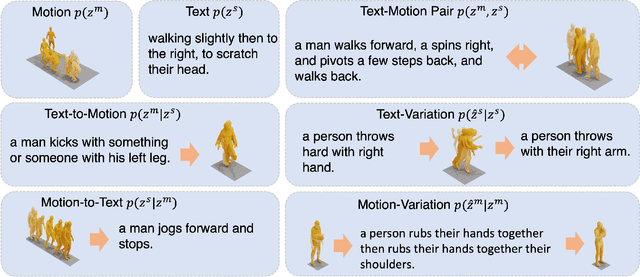
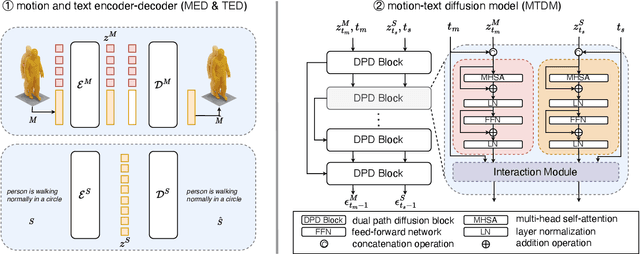
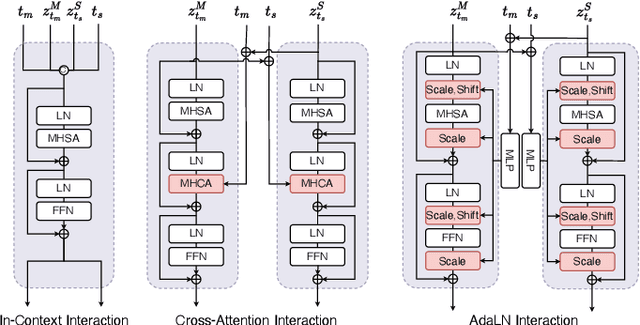
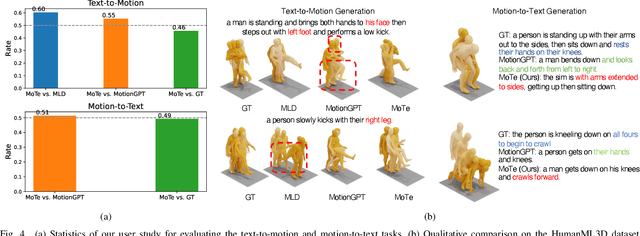
Recently, human motion analysis has experienced great improvement due to inspiring generative models such as the denoising diffusion model and large language model. While the existing approaches mainly focus on generating motions with textual descriptions and overlook the reciprocal task. In this paper, we present~\textbf{MoTe}, a unified multi-modal model that could handle diverse tasks by learning the marginal, conditional, and joint distributions of motion and text simultaneously. MoTe enables us to handle the paired text-motion generation, motion captioning, and text-driven motion generation by simply modifying the input context. Specifically, MoTe is composed of three components: Motion Encoder-Decoder (MED), Text Encoder-Decoder (TED), and Moti-on-Text Diffusion Model (MTDM). In particular, MED and TED are trained for extracting latent embeddings, and subsequently reconstructing the motion sequences and textual descriptions from the extracted embeddings, respectively. MTDM, on the other hand, performs an iterative denoising process on the input context to handle diverse tasks. Experimental results on the benchmark datasets demonstrate the superior performance of our proposed method on text-to-motion generation and competitive performance on motion captioning.
Individual Content and Motion Dynamics Preserved Pruning for Video Diffusion Models
Nov 27, 2024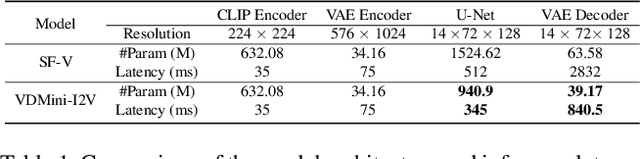
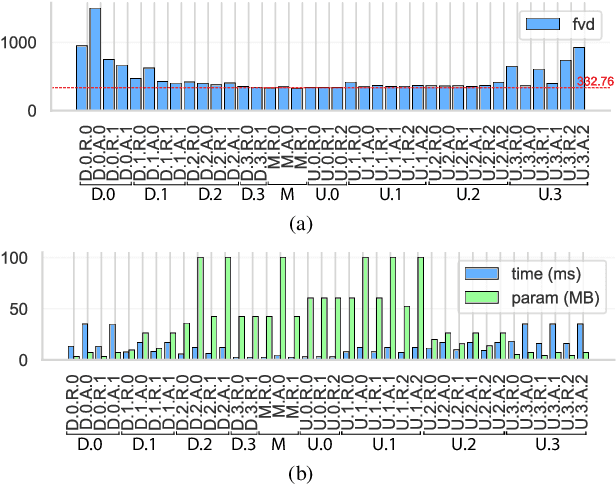
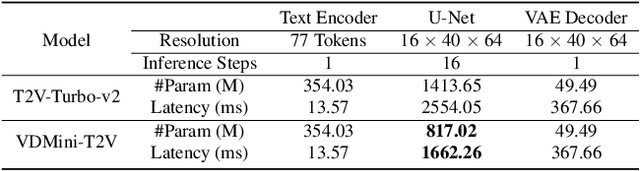
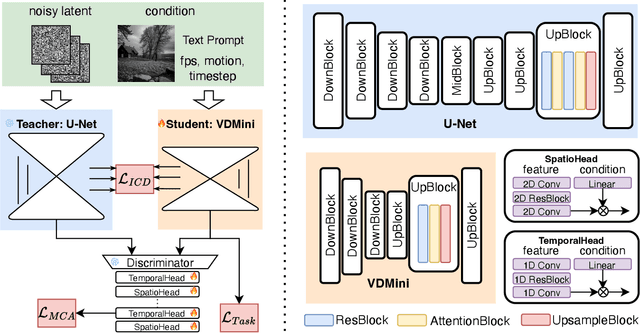
The high computational cost and slow inference time are major obstacles to deploying the video diffusion model (VDM) in practical applications. To overcome this, we introduce a new Video Diffusion Model Compression approach using individual content and motion dynamics preserved pruning and consistency loss. First, we empirically observe that deeper VDM layers are crucial for maintaining the quality of \textbf{motion dynamics} e.g., coherence of the entire video, while shallower layers are more focused on \textbf{individual content} e.g., individual frames. Therefore, we prune redundant blocks from the shallower layers while preserving more of the deeper layers, resulting in a lightweight VDM variant called VDMini. Additionally, we propose an \textbf{Individual Content and Motion Dynamics (ICMD)} Consistency Loss to gain comparable generation performance as larger VDM, i.e., the teacher to VDMini i.e., the student. Particularly, we first use the Individual Content Distillation (ICD) Loss to ensure consistency in the features of each generated frame between the teacher and student models. Next, we introduce a Multi-frame Content Adversarial (MCA) Loss to enhance the motion dynamics across the generated video as a whole. This method significantly accelerates inference time while maintaining high-quality video generation. Extensive experiments demonstrate the effectiveness of our VDMini on two important video generation tasks, Text-to-Video (T2V) and Image-to-Video (I2V), where we respectively achieve an average 2.5 $\times$ and 1.4 $\times$ speed up for the I2V method SF-V and the T2V method T2V-Turbo-v2, while maintaining the quality of the generated videos on two benchmarks, i.e., UCF101 and VBench.
Towards Small Object Editing: A Benchmark Dataset and A Training-Free Approach
Nov 03, 2024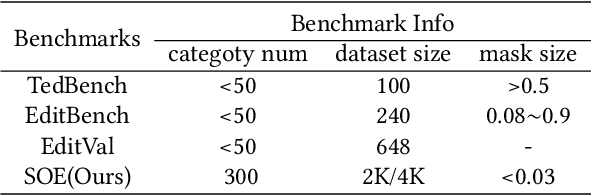
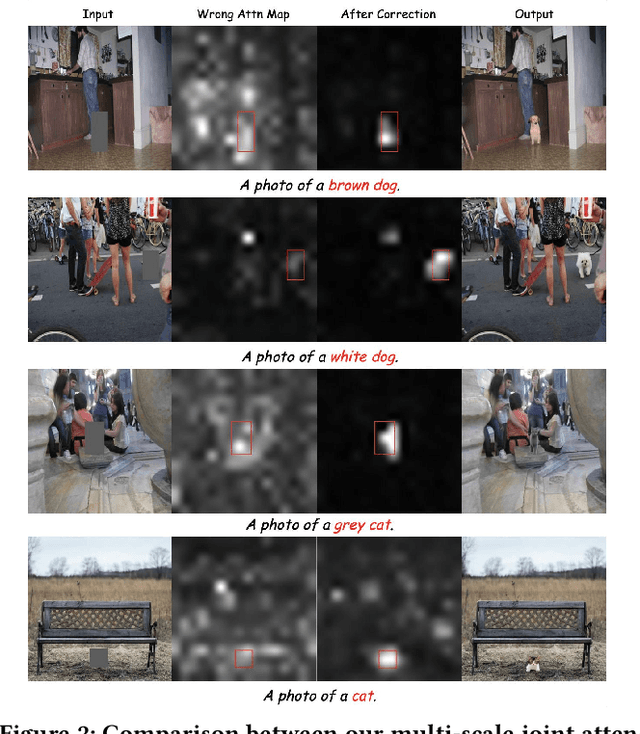
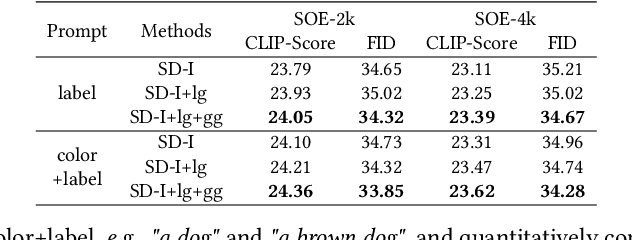
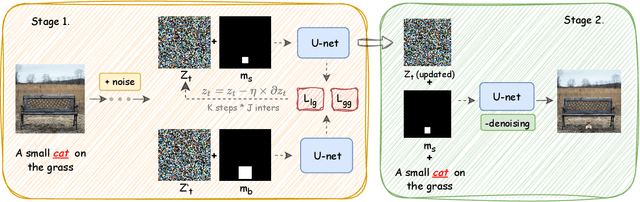
A plethora of text-guided image editing methods has recently been developed by leveraging the impressive capabilities of large-scale diffusion-based generative models especially Stable Diffusion. Despite the success of diffusion models in producing high-quality images, their application to small object generation has been limited due to difficulties in aligning cross-modal attention maps between text and these objects. Our approach offers a training-free method that significantly mitigates this alignment issue with local and global attention guidance , enhancing the model's ability to accurately render small objects in accordance with textual descriptions. We detail the methodology in our approach, emphasizing its divergence from traditional generation techniques and highlighting its advantages. What's more important is that we also provide~\textit{SOEBench} (Small Object Editing), a standardized benchmark for quantitatively evaluating text-based small object generation collected from \textit{MSCOCO} and \textit{OpenImage}. Preliminary results demonstrate the effectiveness of our method, showing marked improvements in the fidelity and accuracy of small object generation compared to existing models. This advancement not only contributes to the field of AI and computer vision but also opens up new possibilities for applications in various industries where precise image generation is critical. We will release our dataset on our project page: \href{https://soebench.github.io/}{https://soebench.github.io/}.